Ouroboros in Gothic Symbolism: Meaning, Origins, and Why the Serpent Still Fascinates
Jony ·
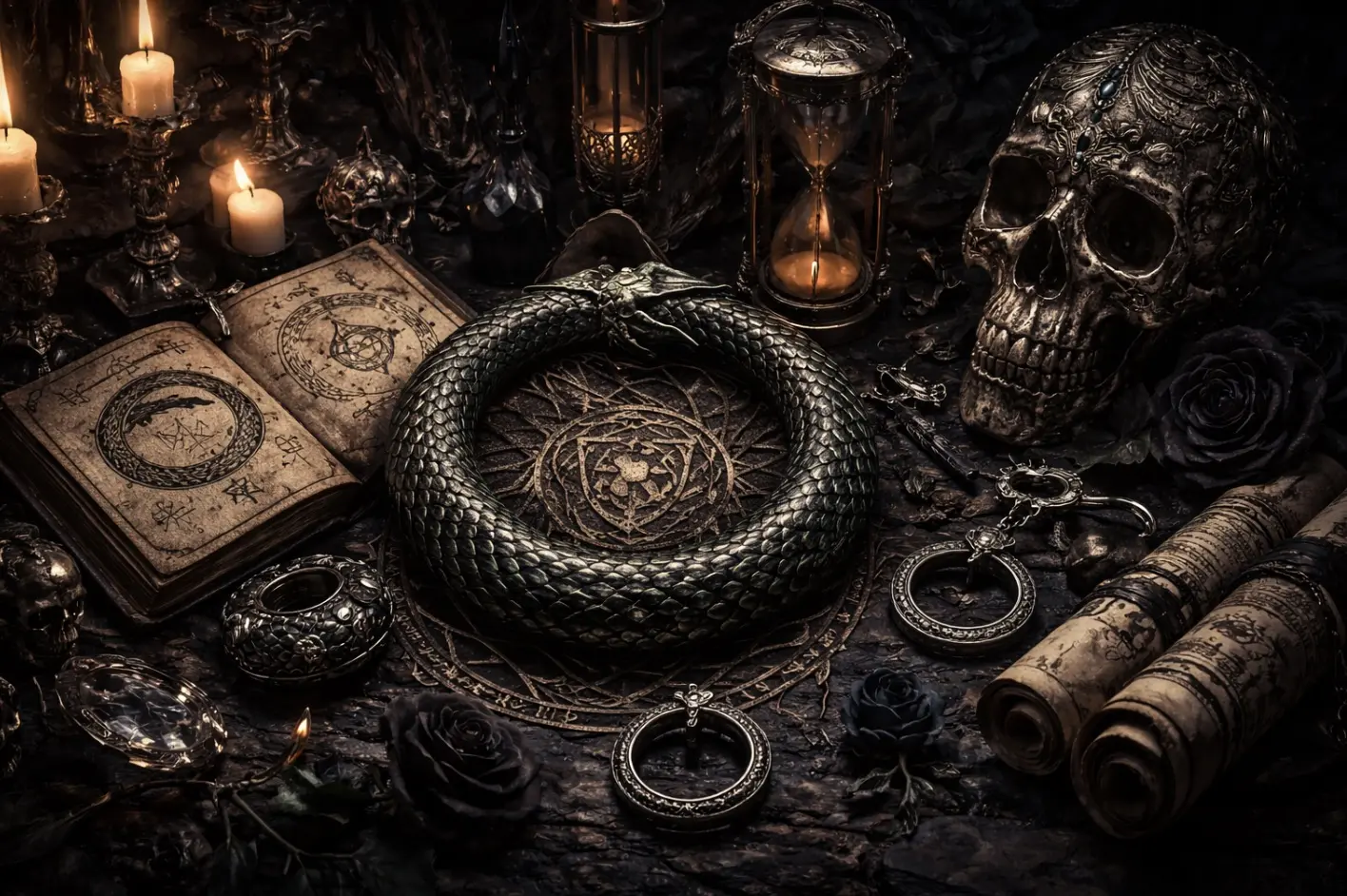
Picture a serpent or dragon suspended in an eternal moment, its body curved into a perfect circle, its jaws closing around its own tail. This haunting image is the Ouroboros—one of the most enduring symbols in myth, esoteric thought, and Gothic aesthetics. For centuries, it has appeared in ancient manuscripts, alchemical texts, jewellery, and contemporary tattoo parlours, speaking to a fundamental human preoccupation: the cycles of life, death, and transformation. The symbol’s fascination lies in its refusal to offer easy answers. It whispers of endings that birth beginnings, of self-destruction as renewal, of the tension between darkness and transcendence. This exploration will take us through the Ouroboros’s origins, its layered meanings, its place in Gothic culture, and why it remains powerfully relevant in modern visual and personal identity.
What Is the Ouroboros?
A symbol formed by a circle
The Ouroboros is elegantly simple: a serpent or dragon rendered as a closed loop, consuming its own tail. This visual power cannot be overstated. The moment we see it, the eye completes a circuit; nothing escapes, nothing enters from outside. This closed geometry naturally evokes themes of eternity, return, continuity, and self-contained power. There is no beginning or end—only an infinite cycle. The image itself becomes the message: life does not move in a straight line toward some distant destination. Instead, it curves back upon itself, eternally, inescapably.
What does the name “Ouroboros” mean?
The name derives from ancient Greek: oura (tail) and boros (eating or devouring). Ouroboros literally means “tail-eater”—a simple, visceral description of the act depicted. Yet within this root lies a profound symbolic truth: the act of self-consumption is also an act of self-renewal. The serpent does not diminish; it regenerates. The name itself encodes the paradox that sits at the symbol’s heart.
Where Did the Ouroboros Come From?
Ancient Egyptian origins
The Ouroboros first appeared in ancient Egyptian iconography, where it was associated with cosmic cycles, the eternal return of the sun, and protection against chaos. Early representations show the serpent as a guardian of sacred space and cyclical time. The Egyptians understood something fundamental about existence: the sun dies each night and is reborn each morning; the Nile floods and recedes with clockwork regularity; seasons turn in their ordained circles. The Ouroboros became a visual shorthand for this cosmic rhythm.
Greek, Gnostic, and alchemical traditions
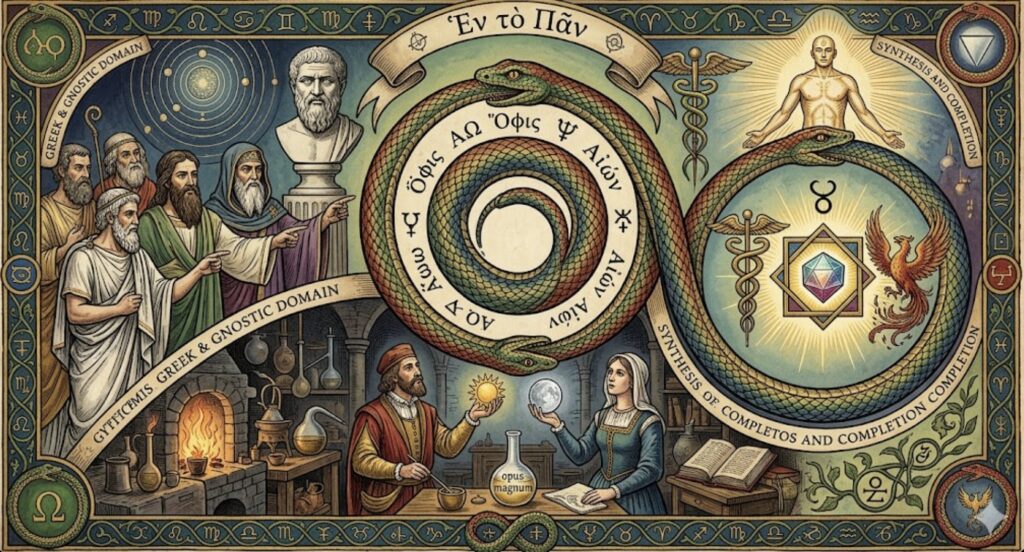
As Western esoteric traditions developed, the symbol moved with them. Greek philosophers and later Gnostic thinkers embraced the Ouroboros as an emblem of eternity and unity—the snake eating its tail representing the cyclical nature of existence and the unity of all things. Medieval and Renaissance alchemists made extensive use of the symbol, viewing it as representing the marriage of opposites and the Great Work of transformation. In alchemical texts, the Ouroboros often appears alongside other symbols of completion, suggesting that the ultimate goal of alchemical practice was a perfected return to the beginning, transformed and enlightened.
What Does the Ouroboros Symbolise?
Life, death, and rebirth
The circular image naturally evokes recurring cycles. At its most visceral level, the Ouroboros represents mortality and regeneration—the understanding that endings often produce new beginnings. In Gothic aesthetics, this resonates deeply: there is a strange acceptance of decay and death, yet also a recognition of renewal. The symbol suggests that destruction and creation are not opposites, but partners in an eternal dance.
Creation and destruction in one image
Here lies the paradox at the symbol’s centre. The Ouroboros can represent magnificent self-renewal and transformation, yet it can also evoke obsession, endless repetition, or even collapse. Is the serpent consuming itself in triumph or despair? The beauty of the symbol is that it holds both possibilities simultaneously. It mirrors the human condition: we create and destroy ourselves constantly, and both acts are inseparable.
Wholeness, duality, and inner conflict
The Ouroboros also suggests balance between opposites—light and dark, body and spirit, life and decay, self and shadow. Unlike symbols that aim to resolve tension through synthesis, the Ouroboros embraces paradox. It does not reconcile these opposites; it holds them in eternal tension, unified by the snake’s unbroken form.
Why Does the Ouroboros Fit Gothic Symbolism So Well?
Gothic fascination with beauty and ruin
Gothic culture has always been drawn to themes of mortality, decay, romantic darkness, and spiritual tension. These are not morbid preoccupations but aesthetic and philosophical ones. The Ouroboros feels entirely at home here. A symbol of eternal return, of cyclical decay and renewal, speaks directly to the Gothic sensibility. It transforms death from an endpoint into a passage, a necessity, even a kind of beauty.
The appeal of mystery and paradox
Gothic culture embraces symbols that refuse a single meaning. The Ouroboros is simultaneously elegant and unsettling, ancient and urgently modern. It cannot be pinned down—much like Gothic aesthetics themselves. This resistance to interpretation is precisely what makes it so compelling in Gothic art, fashion, and philosophy.
A perfect emblem for transformation
The symbol resonates strongly with people drawn to reinvention, self-discovery, and darker aesthetics. For those who have survived hardship, rebuilt themselves, or embraced transformation as a core part of their identity, the Ouroboros speaks a truth that transcends trend.
Is the Ouroboros a Satanic Symbol?
This question appears frequently in online searches, and deserves a direct answer: the Ouroboros is not inherently satanic in origin. It predates modern satanic associations by millennia, appearing across Egyptian, Greek, Gnostic, Hermetic, and alchemical traditions—many of them deeply spiritual rather than antagonistic to mainstream religion. In contemporary Gothic and occult-inspired aesthetics, the symbol may be used for atmosphere, symbolism, or personal meaning rather than doctrinal belief. Its longevity and cultural depth should not be collapsed into the symbolic vocabulary of any single ideology.
Ouroboros in Gothic Jewellery, Art, and Tattoos
The Ouroboros has found particular favour in Gothic jewellery, appearing in elegant rings, necklaces, pendants, and bracelets. The circular form is inherently powerful in jewellery design—it suggests completion, protection, and cyclical strength. Wearers are often drawn to it for both aesthetic reasons and personal symbolism.
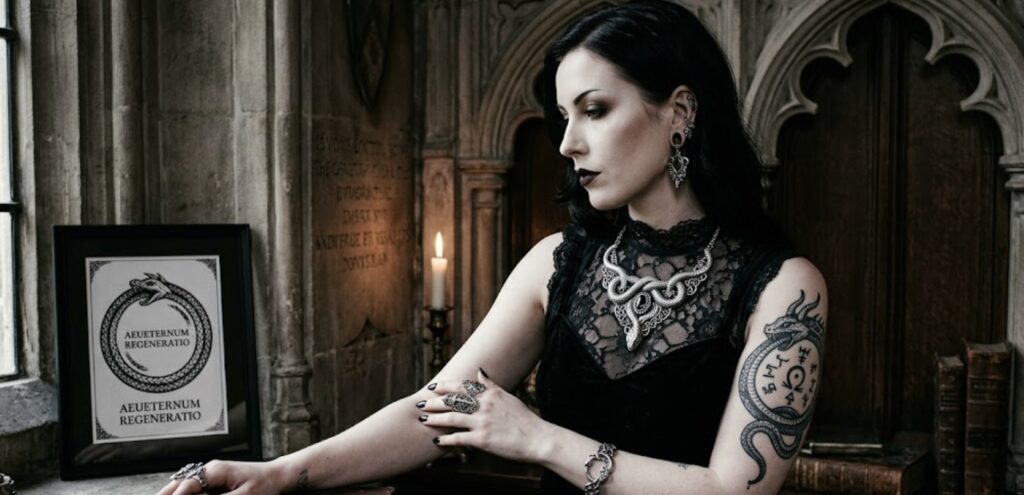
In tattoo culture, Ouroboros designs remain consistently popular. People choose them to mark personal renewal, survival after hardship, acceptance of cyclical change, or simply fascination with dark symbolism. A small serpent on the wrist or a large back piece—the design adapts to the wearer’s vision.
In Gothic art and visual culture, the symbol appears naturally in illustration, engraving, blackwork, and alternative fashion. The dramatic, self-contained serpent motif photographs beautifully, renders well in both ornate and minimalist styles, and carries immediate visual and conceptual weight.
Related Symbols
Those drawn to the Ouroboros often explore related symbols: the world serpent (Jörmungandr) from Norse mythology, alchemical circles, lunar cycles, and other serpent imagery associated with transformation and mystery.
Why the Ouroboros Still Matters Today
In an era of constant change and reinvention, the Ouroboros offers something grounding: the acknowledgement that cycles are fundamental, that endings are beginnings, that transformation is not departure but return. The symbol remains powerful in fashion, philosophy, tattoo culture, and Gothic aesthetics because it is simultaneously ancient and contemporary, personal and universal.
Conclusion
The Ouroboros endures because it captures a truth people keep returning to: life is rarely linear. It curves, cycles, transforms, and always comes around again. The symbol holds both darkness and renewal in the same shape, which is precisely why it has fascinated seekers, philosophers, artists, and everyday people for more than three thousand years. In the serpent’s tail, we see our own eternal return.

Custom Father’s Day Gifts That Feel Personal Without Being Predictable
Custom Father’s Day gifts are popular because they feel more personal than something picked from
Jun

Father’s Day Jewellery Gifts: Bracelets, Necklaces and Accessories for Dads
Father’s Day jewellery gifts can feel personal, lasting and more considered than another mug or
Jun

Father’s Day Gift Basket Ideas for Dads Who Like Practical Gifts
A Father’s Day gift basket is a good choice when one gift does not feel
Jun

Last-Minute Father’s Day Gifts That Still Feel Thoughtful
Left Father’s Day a little too late? You are not the only one. The good
Jun

Best Father’s Day Gifts for Dads Who Like Something Different
Finding the right Father’s Day gift can be harder than it looks. Most dads already
Jun
Gothic Earrings 2026: Dark & Dramatic Styles for Every Goth Aesthetic
Gothic earrings are one of the easiest ways to add darkness, movement and personality to
Jun
Gothic Choker Necklace: The Ultimate Style & Buying Guide 2026
A gothic choker necklace is one of the fastest ways to make a dark outfit
Jun
What Is Gothic Chainmail Jewelry? A Complete Guide to Dark Handmade Jewellery
Gothic chainmail jewelry is dark, handcrafted jewellery made from interlinked metal rings, inspired by armour,
Jun