

The Leviathan Cross stands as one of the most striking symbols in occult and gothic aesthetics—a visual emblem that commands attention with its bold geometry and layered history. Also known as the Brimstone Cross or the sulfur symbol, this double-crossed design topped with an infinity sign has captivated artists, occultists, and those drawn to gothic culture for centuries. But what does it actually mean, where did it come from, and why has it become so prevalent in modern tattoos, fashion, and jewellery? This article explores the rich history, genuine symbolism, and common misconceptions surrounding the Leviathan Cross, revealing why this ancient alchemical sign continues to resonate with those who embrace the darker and more mystical sides of aesthetic expression.
What Is the Leviathan Cross?
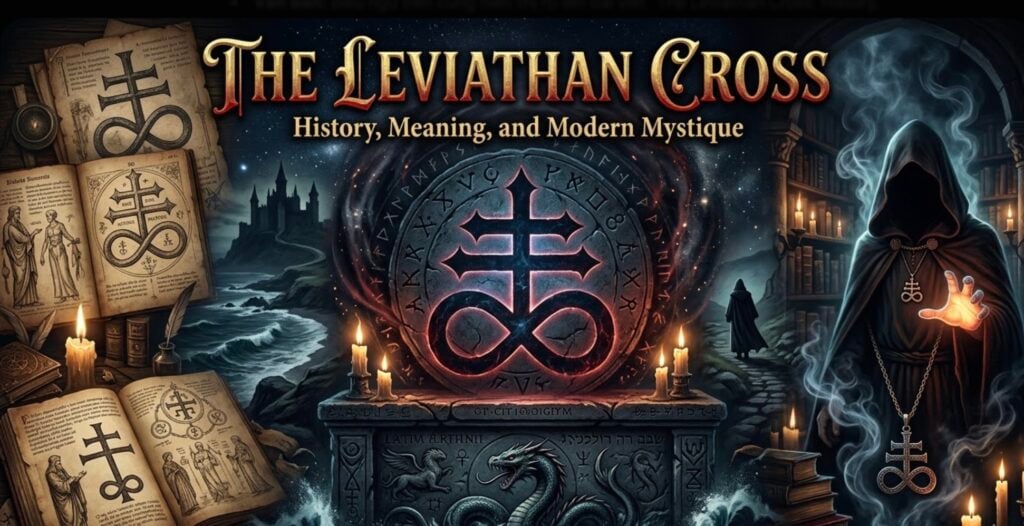
The Leviathan Cross is a striking geometric symbol composed of two primary elements: a double cross positioned at the top and an infinity sign (or lemniscate) forming the base. The overall effect is one of symmetry and power—a symbol that feels both ancient and deliberately designed, with sharp lines that translate beautifully into blackwork tattoos, metalwork, and graphic design.
The double cross itself has historical roots in Christian iconography, but the addition of the lemniscate below transforms it into something distinctly different. The infinity symbol at the base creates a sense of boundlessness, while the crossed points above suggest duality and spiritual complexity. This combination gives the symbol a visual weight that appeals strongly to gothic aesthetics—it is dramatic without being chaotic, intricate without being ornate. The design feels powerful and recognizable at any size, whether displayed as a tiny pendant or a large back tattoo, making it enduringly popular in alternative fashion and jewellery.
Leviathan Cross Origin: Where Does the Symbol Come From?
The strongest historical thread linking the Leviathan Cross is its connection to alchemy—the medieval and early modern practice of chemical experimentation, spiritual transformation, and the search for universal truths. In alchemical texts and symbols, the Leviathan Cross is consistently associated with sulfur (also called brimstone, an older term for the same element). Sulfur held profound significance in alchemical work, representing volatility, transformation, and the transformative power of fire.
The symbol appears in various alchemical manuscripts and grimoires as a representation of sulfur’s properties and spiritual correlates. However, it is important to note that the Leviathan Cross’s symbolic history extends beyond alchemy alone. Its popularity in modern culture often stems from later occult revival movements and, more recently, its association with contemporary Satanic imagery—particularly through connections to LaVeyan Satanism, as documented in modern occult texts.
What’s crucial to understand is that the symbol’s appearance in modern Satanic contexts does not erase or redefine its original alchemical heritage. Instead, the Leviathan Cross exists across multiple layers of symbolic meaning, each influenced by the historical period, cultural context, and individual interpretation. Modern readers and wearers often encounter the symbol through contemporary occult traditions, but this does not mean that older, more neutral symbolic associations have ceased to exist.
What Does the Leviathan Cross Mean?
Symbolism is rarely fixed or singular, and the Leviathan Cross exemplifies this principle. The meaning of this symbol can be broken into its constituent parts, each contributing to the whole:
The Infinity Sign: The lemniscate at the base represents continuity, eternity, and the endless cycle. It speaks to concepts of perpetual motion, eternal return, and the boundless nature of existence. This component introduces a sense of timelessness to the symbol.
The Double Cross: The crossed lines at the top embody duality, balance, and the tension between opposing forces. In spiritual and philosophical contexts, this can represent the interplay between the material and spiritual worlds, between conscious and unconscious, or between chaos and order. The crossing itself suggests conflict, resolution, or the harmonious union of seemingly contradictory forces.
Taken together, the Leviathan Cross suggests power, rebellion, knowledge, transformation, and the eternal. For some, it evokes the concept of mastery over one’s own nature; for others, it represents a fascination with the mysteries that lie beyond conventional understanding. The beauty of this symbol is that its meaning remains interpretive—it invites each observer to find significance according to their own beliefs, aesthetic sensibilities, and spiritual inclinations.
Why Is It Called the Brimstone Symbol?
Brimstone is an archaic English word for sulfur, a substance that held enormous significance in medieval and alchemical thought. Sulfur was associated with fire, heat, transformation, and combustion. In religious contexts, particularly in Christian and Islamic traditions, brimstone became linked with hellfire, divine punishment, and purification through destruction. The phrase “fire and brimstone” became synonymous with apocalyptic judgment.
In alchemy, sulfur represented one of the three primary principles (alongside mercury and salt), embodying the active, volatile, and transformative aspect of matter and spirit. The Leviathan Cross, as the sulfur symbol, thus carries these associations: transformation, intensity, and the destructive-creative power of fire.
Over time, as the symbol gained visibility in modern occult and Satanic traditions, its brimstone connection took on darker, more feared interpretations. The historical and religious associations of brimstone with divine wrath and damnation contributed to the symbol’s current reputation as something explicitly “dark” or “evil”—even though its original alchemical meaning was far more neutral and focused on the principle of transformation itself.
Is the Leviathan Cross Always Satanic?
This is perhaps the most important question to address directly: No, the Leviathan Cross is not inherently Satanic, though many people now associate it with Satanism because of its visibility in modern occult movements.
The misconception arises partly from the symbol’s modern popularity in contemporary Satanic imagery and practice. However, association does not equal definition. A symbol’s historical origin does not vanish simply because it has been adopted into new contexts. The Leviathan Cross’s roots in alchemy—a tradition concerned with spiritual and material transformation, not with worshipping Satan—remain valid and historically documented.
What we see in the Leviathan Cross is a symbol that has been reinterpreted across centuries. Medieval alchemists used it to denote sulfur without any explicit connection to Satanism. Later occultists and modern practitioners have drawn their own meanings from its geometry and historical resonance. Neither interpretation completely overwrites the other; instead, they coexist, layered upon one another.
The key to responsible symbol interpretation is understanding context. A person wearing a Leviathan Cross tattoo might do so because they are fascinated by alchemy, drawn to its gothic aesthetic, interested in occult symbolism more broadly, or seeking a personal emblem of inner strength and transformation. The symbol itself is a vessel—its meaning depends far more on the intention and knowledge of the wearer than on any fixed, universal definition.
Leviathan Cross in Gothic Culture, Fashion, and Tattoos
The Leviathan Cross has become iconic in gothic culture and aesthetics, and for good reason. The symbol embodies many of the core values and visual sensibilities that appeal to those drawn to the gothic aesthetic:
Dark Elegance: The Leviathan Cross is visually sophisticated without being ornate. Its clean lines and balanced geometry create an impression of refined darkness—powerful but not chaotic.
Occult Mystique: In gothic culture, there is deep appreciation for symbols that carry historical weight and mysterious significance. The Leviathan Cross delivers both, offering a visual gateway into alchemy, occultism, and esoteric knowledge.
Strong Blackwork Potential: The symbol translates beautifully into tattoo work, particularly in blackwork and blackline styles. Its geometric precision means it remains clear and striking at any size, from a small pendant to a full back piece.
Symbolism of Individuality and Intensity: In gothic subculture, symbols are often chosen as markers of personal identity and intensity of spirit. The Leviathan Cross signals a wearer or collector who engages with darker aesthetics and is unafraid of symbols that carry unconventional meanings.
Common applications of the Leviathan Cross in modern gothic fashion and jewellery include:
- Necklaces and pendants: Often rendered in silver or blackened metals
- Rings: Statement rings and signet rings featuring the symbol
- Tattoos: Primarily in blackwork, fine line, and geometric styles
- Graphic prints: Appearing on clothing, posters, and band merchandise
- Jewellery boxes and decorative objects: Engraved or inlaid into gothic home décor
For those with an appreciation for occult symbolism and dark aesthetics, the Leviathan Cross represents a perfect intersection of history, meaning, and visual impact.
Leviathan Cross Tattoo Meaning: What Do People Mean by It Today?
A tattoo is one of the most personal applications of any symbol. While the Leviathan Cross carries historical meaning tied to alchemy and the occult, the significance of a Leviathan Cross tattoo today is largely determined by the wearer’s intention.
For many people, a Leviathan Cross tattoo may represent:
- Personal Freedom: A rejection of convention and mainstream values, with an embrace of one’s own path
- Rejection of Convention: A visual statement that the wearer does not adhere to ordinary expectations or beliefs
- Fascination with Occult Symbolism: A genuine interest in esoteric traditions, alchemy, and the mysteries of the spiritual world
- Inner Strength: The symbol’s association with transformation and duality makes it a powerful emblem of personal power and resilience
- Transformation: The wearer may see the symbol as a marker of their own journey of change and spiritual evolution
It is important to recognize that tattoo meaning is deeply personal. Two people wearing identical Leviathan Cross tattoos may hold entirely different interpretations of what the symbol means to them. One person might see it as a purely aesthetic choice driven by gothic sensibilities; another might view it as a spiritual statement. Both interpretations are valid. The beauty of symbols is that they allow individuals to project their own meaning onto a form that resonates with them visually and spiritually.
When considering a Leviathan Cross tattoo, the most important question is: What does this symbol mean to you? Your answer is the truest meaning your tattoo will carry.
How to Read the Symbol Responsibly
In an age of rapid information sharing and internet-driven mythmaking, it is easy for symbols to become flattened into caricatures or sensationalized versions of themselves. The Leviathan Cross is particularly susceptible to this treatment because of its association with darkness and the occult.
Responsible symbol interpretation requires:
- Separating historical fact from internet mythology: Seek out primary and credible sources. The strongest historical connection for the Leviathan Cross is its alchemical use as a sulfur symbol—a fact documented in historical texts and recognized by symbol scholars.
- Understanding context: Consider where and when the symbol appeared, who used it, and what it meant to them. A symbol’s meaning in medieval alchemy differs from its use in 20th-century occultism or 21st-century fashion.
- Recognizing wearer intent: If you encounter someone wearing or displaying a Leviathan Cross, avoid making assumptions about their beliefs or character based solely on the symbol. Ask questions, or simply recognize that their interpretation may differ from yours.
Symbols are tools for communication and personal expression—they carry more nuance and complexity than sensationalized retellings suggest.
The Leviathan Cross is visually simple but symbolically profound—a geometric form that has journeyed across centuries, carrying with it layers of meaning from alchemy, occultism, spirituality, and modern gothic culture. It is a symbol that speaks to those drawn to transformation, to darkness, and to the mysteries that lie beyond the everyday world. Whether encountered in a medieval alchemical manuscript, a contemporary tattoo, a piece of gothic jewellery, or a band logo, the Leviathan Cross continues to hold power.
Understanding its history—from its roots in sulfur symbolism to its modern iterations—allows us to appreciate it not as a simplistic emblem of evil, but as a complex symbol that reflects humanity’s enduring fascination with transformation, duality, and the eternal. In gothic culture and beyond, the Leviathan Cross remains a potent reminder that the most compelling symbols are those that resist easy definition, inviting each generation to discover new meaning within their elegant lines.
The Leviathan Cross: History, Meaning, and Modern Mystique
Table of ContentsWhat Is the Leviathan Cross?Leviathan Cross Origin: Where Does the Symbol Come From?What
Mar
Gothic Bat Symbolism: Meaning, History, and Dark Aesthetics in Gothic Culture
Table of ContentsWhat Is the Leviathan Cross?Leviathan Cross Origin: Where Does the Symbol Come From?What
Mar

Skulls in Gothic Symbolism: Meaning, History and Dark Aesthetics
Table of ContentsWhat Is the Leviathan Cross?Leviathan Cross Origin: Where Does the Symbol Come From?What
Mar

Mercury (☿) Gothic Symbols: Meaning, Mythology, and Occult Influence in Gothic Culture
Table of ContentsWhat Is the Leviathan Cross?Leviathan Cross Origin: Where Does the Symbol Come From?What
Mar
Ankh (☥) Gothic Symbol: Meaning, Origins, and Why the Ancient Egyptian Ankh Became an Icon in Goth Culture
Table of ContentsWhat Is the Leviathan Cross?Leviathan Cross Origin: Where Does the Symbol Come From?What
Mar

Hobbiton Movie Set Review: Is New Zealand’s Famous Shire Experience Really Worth It?
Table of ContentsWhat Is the Leviathan Cross?Leviathan Cross Origin: Where Does the Symbol Come From?What
Mar

World Goth Day: History, Meaning, and How the Global Goth Community Celebrates Goth Day
Table of ContentsWhat Is the Leviathan Cross?Leviathan Cross Origin: Where Does the Symbol Come From?What
Mar

Whitby Goth Weekend (WGW): The Legendary Gothic Festival That Transforms Whitby Each Year
Table of ContentsWhat Is the Leviathan Cross?Leviathan Cross Origin: Where Does the Symbol Come From?What
Mar
