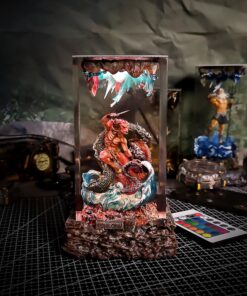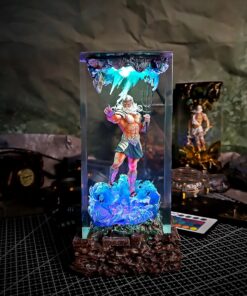

In the vast pantheon of Greek mythology, few deities command as much awe and reverence as Poseidon, one of the Twelve Olympians. Known as the God of the Sea, Earthquakes, and Horses, Poseidon ruled over the unpredictable depths of the ocean, wielding power that could both nurture life and unleash catastrophic fury. His symbols for Poseidon encapsulate this duality, reflecting his immense authority, volatile temperament, and deep connection to the natural world. Central among these is the iconic Poseidon trident, a three-pronged spear that has become synonymous with marine dominion. This article delves into the rich symbolism surrounding Poseidon, exploring his Greek origins and his Roman counterpart, Neptune, whose shared imagery continues to captivate modern imaginations.
The Trident: Poseidon’s Ultimate Symbol of Power
At the heart of Poseidon’s mythology lies the Greek god Poseidon trident, his most recognisable and potent emblem. This formidable weapon, often depicted as a towering staff with three sharp prongs, was not merely a tool but an extension of the god’s will. According to ancient tales, the Poseidon god trident was forged by the Cyclopes—those one-eyed giants imprisoned in Tartarus—during the Titanomachy. As a gift to Poseidon alongside Zeus’s thunderbolt and Hades’s helm of darkness, it granted him unparalleled control over the seas.

The trident’s design symbolises authority, destruction, and creation in equal measure. With a single strike, Poseidon could stir up tempestuous storms, shatter the earth to cause earthquakes, or calm turbulent waters to ensure safe passage for sailors. This versatility underscores his role as a temperamental yet protective deity. In artistic representations, the Greek god Poseidon trident is frequently shown grasped firmly in his hand as he rides a chariot pulled by hippocamps—mythical sea-horses.
Comparatively, the Neptune Poseidon trident in Roman mythology mirrors this imagery closely. Neptune, Poseidon’s equivalent, adopted the trident as his primary attribute, appearing on coins, mosaics, and sculptures throughout the Roman Empire. While Greek depictions emphasised Poseidon’s raw, elemental fury, Roman art often portrayed Neptune with a more regal, stabilising presence, reflecting the empire’s seafaring ambitions. Nonetheless, the neptune poseidon trident retained its core symbolism of maritime strength.
Culturally, the Poseidon trident has transcended ancient lore to become an emblem of marine prowess. It adorns naval flags, inspires tattoo designs symbolising resilience against life’s storms, and even influences modern branding for ocean-related enterprises. The Greek god Poseidon trident remains a timeless icon of unyielding power.
Other Symbols Associated with Poseidon
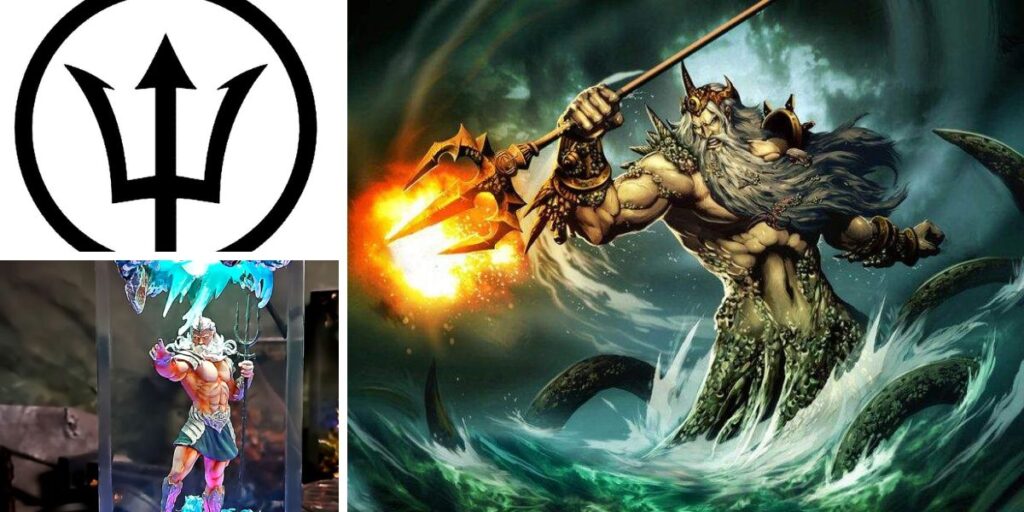
Beyond the trident, a constellation of symbols for Poseidon enriches his mythological profile, each tied to his domains and personality. These emblems appear in ancient vase paintings, temple friezes, and sculptures, offering insights into how the Greeks perceived their sea god.
Horses hold a prominent place among symbols Poseidon created. Poseidon was credited with inventing the first horse, striking the ground with his trident to bring forth these magnificent creatures from the earth. They represent strength, speed, and the restless motion of waves, embodying his earthy and equestrian aspects.
Dolphins, playful yet intelligent marine mammals, symbolise Poseidon’s benevolent side. As guides for lost sailors and messengers of calm seas, they feature in myths where Poseidon transforms beings into dolphins or employs them in his court. Bulls, sacrificed in his honour during festivals like the Isthmian Games, signify fertility, raw power, and the god’s association with seismic forces—their charging akin to an earthquake’s rumble.
Natural elements like seafoam and crashing waves serve as organic symbols for Poseidon, evoking the frothy aftermath of his trident strikes or the endless rhythm of tides. In ancient art, these are depicted swirling around his figure, while modern interpretations incorporate them into jewellery and digital art, preserving their cultural resonance.
The Mythic Craftsmanship: The Real Poseidon Trident
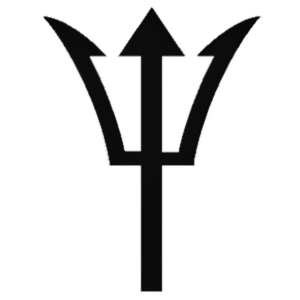
Delving deeper into legend, the “real Poseidon trident” emerges as a masterpiece of divine artistry. Crafted by the Cyclopes from an otherworldly metal—perhaps adamantine, the same indestructible substance as Zeus’s thunderbolts—this poseidon trident real was no ordinary weapon. Its three prongs hold profound symbolic weight in Greek mythology: one for the sea’s vast expanse, another for the earth’s quaking core, and the third for the galloping horses that bridge land and water.
This triune design reflects the mystical significance of the number three in Hellenic thought—representing harmony, completeness, and the interconnected realms of Poseidon’s influence. The real poseidon trident was said to shimmer with an ethereal glow, capable of splitting rocks or summoning springs, as in the myth where Poseidon competed with Athena for Athens by gifting a saltwater spring.
Modern fascination with this artefact has sparked a thriving market for replicas. Searches for “poseidon’s trident for sale” yield an array of collectibles, from ornate prop weapons for cosplay to hand-forged metal sculptures evoking ancient craftsmanship. These items allow enthusiasts to own a piece of mythic history, symbolising admiration for Poseidon’s commanding presence. Whether in museums or online marketplaces, the poseidon trident real continues to inspire awe and creativity.
Read more: Symbols for Zeus: Unravelling the Divine Power of the King of Greek Gods
Poseidon and Neptune: Shared Legacy and Symbolic Unity
The transition from Greek to Roman mythology seamlessly integrated Poseidon’s symbols into Neptune’s repertoire, creating a unified legacy. Both gods shared the trident—poseidons trident in its essence—as a badge of authority over waters. Neptune, however, infused it with Roman pragmatism; his image on imperial coins promoted naval supremacy during expansions across the Mediterranean.
Cultural nuances distinguished them: Poseidon’s temperamental outbursts contrasted with Neptune’s more paternal oversight of seas and horses. Yet, the neptune poseidon trident bridged these worlds, appearing in aqueducts, fountains, and triumphal arches. This shared symbolism extended to seafaring traditions, where sailors invoked Neptune for protection, much as Greeks did Poseidon.
Today, their icons endure in Western culture—from naval emblems like the British Royal Navy’s trident-inspired badges to city seals in coastal towns. Poseidons trident remains a potent motif for organisations embodying strength and exploration.
Poseidon’s Symbolism in Modern Culture and Art
In contemporary society, symbols for Poseidon permeate diverse mediums, adapting ancient motifs to modern narratives. Tattoo artists frequently ink the Greek god Poseidon trident as a symbol of inner strength and independence, often paired with waves or dolphins to convey overcoming adversity.
Logo design draws heavily from these elements; brands in surfing, diving, or environmental conservation use stylised tridents to evoke the ocean’s untamed spirit. Fantasy media amplifies this: in films like The Little Mermaid or Aquaman, trident-wielding sea rulers echo Poseidon. Video games such as God of War feature poseidons trident as a devastating weapon, while literature in series like Percy Jackson reimagines his symbols for young audiences.
Pop culture examples abound—from the Miami Dolphins NFL team logo to trident motifs in superhero comics—highlighting Poseidon’s blend of majesty and menace.
Did You Know? Poseidon’s sacred animal was the horse, and he was said to have created the first one by striking the earth with his trident, birthing a symbol of speed and power that gallops through myth and history.
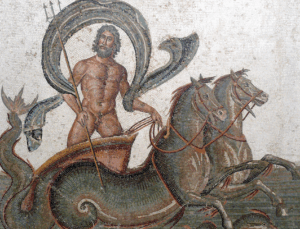
Poseidon’s personality—temperamental yet majestic, destructive but protective—shines through his icons, reminding us of humanity’s complex bond with nature.
Conclusion: The Enduring Power of Poseidon’s Symbols
The symbols for Poseidon, led by the mighty Greek god Poseidon trident, endure as timeless testaments to mythic grandeur. They weave together threads of power, nature, and human fascination, transcending religious boundaries to symbolise our eternal dialogue with the sea’s mysteries. From ancient altars to digital screens, these emblems inspire awe, urging us to respect the ocean’s depths. In a world of constant change, Poseidon’s legacy waves on, a trident thrust towards the horizon of imagination.